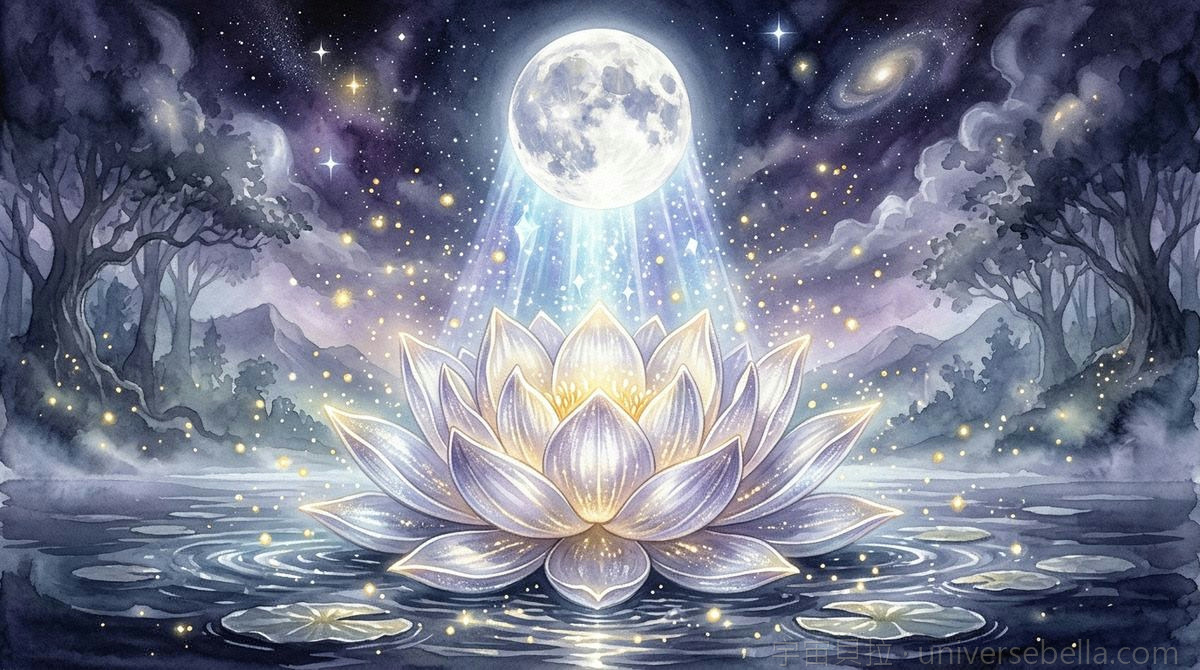
Some nights you can't quite fall asleep. Not because anything is bothering you — it's just that somewhere inside feels full and won't settle. If you pull back the curtain and see a round, bright moon hanging there, it may well be the full moon. A lot of people find that around the full moon their emotions run thicker and their sleep gets lighter, and the things they held back during the day come up, bit by bit, in the night.
If that's exactly where you are, this piece is for you. The full moon isn't only the most beautiful moment in the night sky — in many cultures' traditions, it's also the time of the whole month best suited to stopping, taking a look, and setting some things down.
On the Night of the Full Moon, Energy Peaks — and So Do Emotions
What is a full moon? Astronomically, the full moon is the moment the Moon moves into a position opposite the Sun, with the Earth in between, so the side of the Moon facing us is fully lit. Each lunar cycle runs about 29.5 days, and the full moon falls on day 14 or 15 — the point in the whole cycle when the light is brightest and, by tradition, when energy is considered fullest.
If the new moon is the moment of "starting from zero, planting seeds," the full moon is the moment of "harvest, of seeing." Over half a month, the Moon grows from a thin curved sliver all the way to fullness — and in the language of energy, this stands for something moving from seed to ripeness. So the key words of the full moon aren't "beginning" but "completion" and "release."
The Moon's gravity does pull on the Earth's oceans — and that part has a clear scientific basis: the rise and fall of the tides is precisely the result of the Moon's and Sun's gravity, with the tidal range greatest at the full and new moons. The human body is roughly 60% water, and so since ancient times many people have believed the phases of the moon stir our emotions and energy. While systematic scientific research on "whether the full moon affects human emotions" hasn't reached a consistent conclusion, the subjective sense of restless sleep and fuller emotions on a full-moon night is something many people share. Rather than rushing to judge whether it's scientific, take it as a reminder: tonight, let yourself slow down.
Why the Full Moon Suits Letting Go, Not Wishing
When people hear that the full moon's energy is strong, the first reaction is often, "Then I'd better make a wish, quick!" But in lunar tradition, wishing is really the new moon's job. What the full moon truly suits are two quieter things — gratitude, and release.
The logic flows naturally: at the new moon you plant your intentions; half a month later, when the Moon reaches its fullest, it's the right time to look back and ask, "What have I gained in this stretch of time? How far have I come?" First see what has already happened — then gently set down what you no longer need, what's been keeping you stuck.
Universe Bella once described the full moon this way: "The full moon isn't only for wishing — it's for seeing. Seeing what you already have, seeing how far you've already come. The energy of gratitude is the best fuel for the frequency of abundance." That captures the heart of the full moon clearly — it isn't a moment to ask the universe for more, but a moment to take stock and clear things away.
"Release" sounds abstract, but it's actually very concrete. What you're willing to set down might be a relationship that ended yet still replays in your mind, an old belief like "I'm not good enough" that's trailed you for years, or just the exhaustion and anxiety that piled up this month. A full-moon release ritual gives these things a chance for a proper goodbye. If there's a person or a thing you can't seem to release, this piece on forgiveness and letting go — "If You Can't Let That Person Go, It's Because You're Still Waiting for an Apology" — may keep you company a little further down the road.
Full Moon and New Moon: One Harvests, One Sows
If you're not yet familiar with the lunar phases, picture the new moon and the full moon as the two ends of one line. The new moon, on the darkest night, stands for blankness and beginning; the full moon, on the brightest night, stands for fullness and release. Head and tail, the two of them make up the most natural rhythm of manifestation: at the new moon you plant intentions, at the full moon you harvest and clear away, and then you greet the next new moon and plant fresh intentions again.
This is also why a lunar ritual doesn't have to carry any pressure. You don't have to "get it right," and you can't "miss it" — the Moon comes back every month. Every new moon is a chance to begin again; every full moon is a chance to sort yourself out again. To understand the new-moon end first, read "On the Night of the New Moon, the Moon Is Darkest — Yet Best for Wishing"; and for the full energetic rhythm of all eight phases in one place, "Lunar Energy and Manifestation: The Right Way to Wish at the New Moon and Release at the Full Moon" lays it out more systematically.
A Full Moon Ritual: Five Steps
A full-moon ritual needs no special tools, and you don't have to wait for the exact minute of the full moon. Doing it within three days either side works just as well, and many people choose late at night, once the house has gone quiet. The whole thing takes about 15 to 20 minutes. What matters isn't how elaborate it is, but whether you're truly willing to keep yourself company, quietly, for a while.
Step one: let yourself grow still first. Turn off the main lights; leave a small lamp on, or light a candle. If you can see the moon from your window, let the moonlight in. Sit down, take a few slow, deep breaths, and gather the self that's been rushing forward all month back into the body of this moment.
Step two: give thanks for what happened this month. Take out paper and pen and write down what you're willing to be grateful for this month, big things and small. Not just the "successes" — it can also be "I ate well this month," "Someone was there for me when I was tired," "I got through a really hard week." Gratitude isn't forcing yourself to think positively; it's bringing your attention back to the fact that you already have quite a lot.
Step three: write down what you're willing to release. On a separate sheet, write what you want to set down this month — a thought that's kept you stuck, a draining relationship pattern, an unspoken hurt, or just the stress that's piled up. As you write, there's no need to dress it up or explain it. Just be honest.
Step four: say a proper goodbye to it. Read your "release list" through once, then say farewell to it in a way that means something to you. Some fold the paper away, a sign of handing it over to time; some, safely, tear it up. What counts isn't the gesture itself, but the words inside you: "I am willing to let this go."
Step five: sit quietly under the moonlight for a few minutes. If your surroundings allow, leave a few last minutes to do nothing at all — just sit, feel your breath, feel the moonlight. Let the emotions that have just risen settle slowly. As you finish, you might say one gentle thing to yourself, such as: "Thank you, me, for making it this far."
Fuller Emotions at the Full Moon Are Normal
After the release step, some people feel a weight lift; others find their eyes growing warm, even crying. If that's you, know that it's completely normal, and usually a good sign. When you finally face honestly the things you've kept pressed down, the body naturally responds.
There's a concept in psychology that splits ways of handling emotion into "suppression" and "reappraisal." Suppression means forcing emotion down — it looks effective in the short term, but over the long run it leaves people more drained and lowers their overall sense of well-being. Reappraisal means changing the angle you see something from, rather than pretending it isn't there. A full-moon release ritual is, at heart, an act of reappraisal: you don't deny your sadness; you choose a different angle — "What did this teach me?" "I can carry its lesson while setting down its weight."
A line Universe Bella often says fits well here: "Positivity isn't ignoring negative emotions — it's choosing, on the basis of acknowledging them, the angle you read them from." The full moon doesn't ask you to pretend everything is fine; it gives you a space where you're allowed to feel sad, and then to let go slowly. If you've noticed your emotions swinging hard lately, it doesn't mean something is wrong with you — it's more like your system reminding you: it's time to stop and take care of yourself.
Make the Full Moon Ritual a Monthly Appointment
The most precious thing about a full-moon ritual isn't how grand a thing you did that one night — it's that you gave yourself a steady rhythm for looking back. Once a month, in the few days when the Moon is fullest, sit down and ask yourself: What have I gained this month? What do I want to let go of? And what do I want to carry into the next stretch?
You don't need to do it perfectly. Sometimes you might write only three lines before you want to sleep — that's fine too. What matters is that the feeling of "I'm keeping good company with myself" gathers, full moon after full moon, into a kind of trust in yourself.
If You Only Want to Do One Thing Tonight
If, reading this far, the five steps feel like a bit much, then do just one thing: take a sheet of paper, write down the one thing this month you most want to set down, and gently say to yourself, "I am willing to let this go." The rest can wait until the next full moon — there's still time.
The Moon comes full once every month. It's always there, reminding you: you too can sort yourself out and set off afresh, again and again.
Frequently Asked Questions
Does a full-moon ritual have to be done on the exact day of the full moon?
Not necessarily. Doing it within three days either side of the full moon is considered just as effective energetically. If you're too busy on the day, or not in a good state, a day or two before or after is fine. The heart of a ritual is your focus and intention, not pinpoint timing.
Can I make wishes at the full moon, or only let go?
In lunar tradition, wishing and setting intentions suit the new moon better, while the full moon suits gratitude and release. But this isn't a hard rule. If you'd like to give thanks for something at the full moon, or affirm an intention already in motion, that's perfectly fine. The point is to use the full moon's energy in two directions: seeing what you already have, and releasing what you no longer need.
My emotions ran higher after the ritual, not lower — is that normal?
Very normal. When you face honestly the emotions you've kept suppressed, the body often has a releasing response — wanting to cry, feeling loosened, or tired. This is usually a sign that the emotion has been seen and has started to move. Give yourself some time to rest, drink some warm water, and go to bed early. If the feelings stay so strong that they affect daily life, do seek professional psychological support — that isn't weakness, it's taking care of yourself.
Can I do a full-moon ritual without seeing the moon (cloudy skies, indoors)?
Yes. A ritual's power comes from your inner focus, not from whether your eyes can see the moon. Even on a cloudy night or indoors, the Moon is still in its place. As long as you know "tonight is the full moon," you can grow quiet and go through the steps.
Is full-moon release actually backed by science?
It's worth honestly separating two levels. That the Moon's gravity affects the tides, with the tidal range greatest at the full and new moons, is an astronomical fact with a clear scientific basis. But there's no consistent scientific conclusion that "the full moon affects human emotions or energy." The value of a full-moon ritual is closer to a structured practice of self-reflection and emotional sorting — using a steady rhythm of gratitude and release to help you tend to your inner state. Treating it as a gentle appointment with yourself, rather than a formula guaranteed to work, comes closest to what it really means.