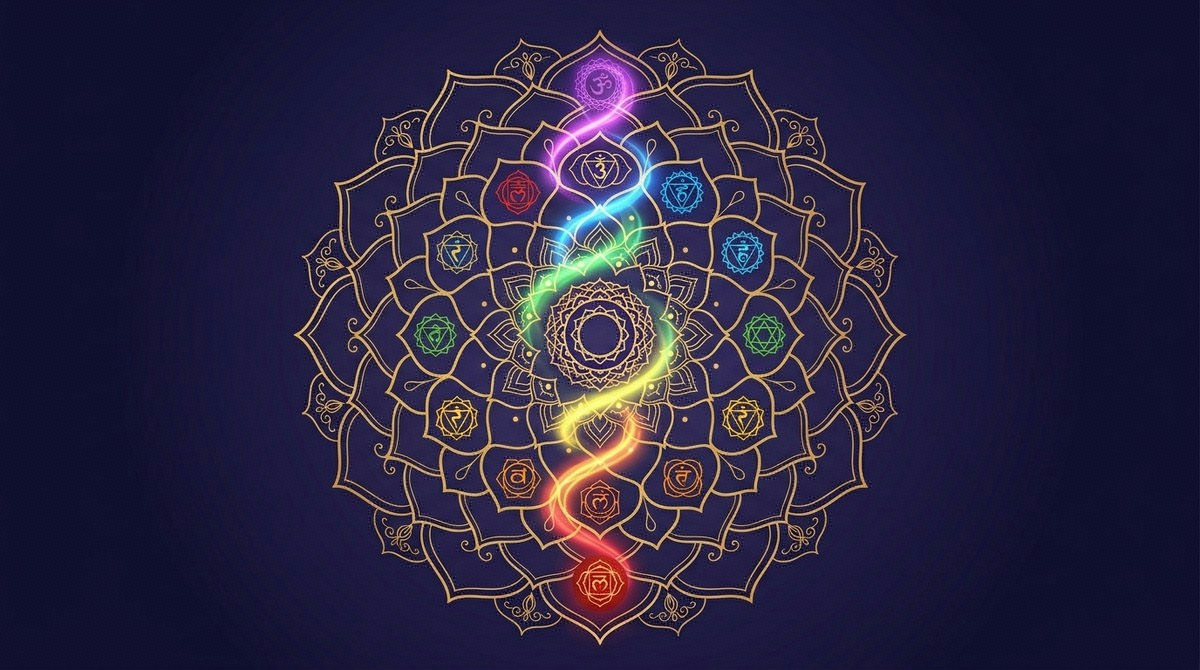
The seven chakras are an energy system that comes out of India's yogic and Tantric traditions. They're the seven main energy centres said to run along the body's central channel, from the base of the spine up to the crown: root, sacral, solar plexus, heart, throat, brow, and crown. They belong to traditional mind-body-spirit culture and work as a tool for personal practice. They are not a religion, and they're not used for medical diagnosis or treatment.
Most people meet the chakras as a list: seven colours, seven locations, seven lessons. But the real value isn't in memorizing that chart. It's in understanding the system behind it — the way energy is said to move through the body. This guide walks you through how the whole system works, then takes the seven chakras one at a time, and finally gives you an honest look at a popular but often overstated idea: that each chakra has its own healing frequency (in Hz).
Let me be clear about where this stands from the start: the chakras aren't a tool for "fixing the body" or "curing illness." They're a framework for practice — a way to notice the state of your body and mind, and to bring your attention gently back to yourself. Come at them this way and you'll use them more comfortably, and you'll be much harder to mislead with exaggerated healing claims.
What Are the Seven Chakras? Start With the Whole System
The word chakra (Sanskrit for "wheel" or "disc") first shows up in India's yogic and Tantric texts. The tradition holds that beyond the physical body we can see and touch, there's also a body made of energy — the "subtle body." The chakras, the energy channels, and the life force all live in this subtle body, not in any single physical organ. In other words, the chakra system is really an energy map of the subtle body.
That's why trying to read a chakra as some literal organ in the body gets you nowhere. It was never an anatomical structure. It's a symbolic language the tradition used to describe states of energy, emotion, and consciousness.
The Chakras Aren't a List — They're an Energy System
To really get why the seven chakras are ordered the way they are, you need a few core ideas that hold the whole system together. These are what actually make it work:
- Nadi (energy channels): The Sanskrit word means "channel" — the pathways life force is said to flow through in the body. The tradition counts countless nadis, three of which matter most: Ida on the left (yin, lunar, cooling), Pingala on the right (yang, solar, warming), and Sushumna, the central axis. The seven chakras are the "wheels" where these channels meet and energy pools — which is the reasoning behind where each one sits.
- Prana (life breath, or life force): The vital energy that flows through the nadis and keeps body and mind alive. Yoga works with prana through pranayama, the practice of controlled breathing. The idea is close to qi in Chinese medicine, though it comes from a different system.
- Sushumna (the central channel): The main energy channel running along the central axis of the spine. The seven chakras are strung along it from bottom to top, like beads on a thread.
- Kundalini (the coiled one): A latent energy the tradition pictures as a serpent coiled at the root chakra. Through long practice, this energy is believed to rise along the central channel, passing through each of the seven chakras in turn until it reaches the crown. This is the core of why the chakras run from bottom to top — energy rising from the most basic concern, survival, all the way up to the most refined, the spiritual.
Put these ideas together and you'll see the chakras aren't seven separate dots. They're a single path of energy that climbs from the bottom up, from survival to spirit. For a shorter definition of each of these terms, see Universe Bella's Manifestation Library (the full glossary).
A Quick Chakra Quiz: Which Chakra Needs Your Attention Right Now?
The seven statements below each line up with one of the seven chakras. Go with your gut and rate how true each one has felt for you "lately." The quiz will point you to the chakra most worth your attention right now and take you to that section. One reminder: this is just a small tool for self-awareness — not a medical or psychological diagnosis.
1. Lately I've often felt uneasy or insecure, or anxious about money and getting by.
2. Lately I've felt flat or numb, or lost my appetite for creativity and fun.
3. Lately I doubt myself easily, can't say no, or don't trust myself.
4. Lately I struggle to give or receive love, put up walls, or am hard on myself.
5. Lately I haven't said what I really mean, or I hold back and try to please.
6. Lately my mind feels scattered and indecisive, or I lean too hard on others' opinions.
7. Lately life feels meaningless, I'm cut off from everything, or I've lost my way.
(Options for each: Not really / Sometimes / Very true)
The Seven Chakras, One by One
Here, in the traditional bottom-to-top order, is each of the seven chakras — its location, its traditional correspondences (colour, element, seed syllable), the area of life it governs, and the symbolic states of "balance" and "imbalance," along with ways to tend to it. A reminder: these correspondences are traditional symbols, and they vary somewhat between lineages. "Balanced" and "imbalanced" are symbolic descriptions for self-reflection, not medical judgments.
1. The Root Chakra (Muladhara) — Safety and Foundation
(caption) The root chakra: red, the element earth, seed syllable LAM.
Location: the base of the spine, around the perineum — the foundation of the whole system. Traditional correspondences: the colour red, the element earth, and the seed syllable LAM.
The root chakra governs the most basic concern of all — survival and safety: whether you feel supported, whether you belong, whether you stand firmly in the world. In traditional terms, when the root is "stable" you feel grounded, settled, and steady enough to act. When it's "out of balance" you may feel anxious and insecure, too afraid of the future — or, the other way, too fixated on money and possessions. Tending to the root is very down-to-earth work: keep a regular rhythm, eat and sleep well, get out into nature, plant your feet on the ground, and bring attention that's drifted up into your head back down into your body.
2. The Sacral Chakra (Svadhisthana) — Emotion and Creativity
(caption) The sacral chakra: orange, the element water, seed syllable VAM.
Location: the lower abdomen, the pelvis, and the reproductive area. Traditional correspondences: the colour orange, the element water, and the seed syllable VAM.
The sacral chakra is about flow, and it governs emotion, desire, creativity, and intimacy. The image of water stands for fluidity and feeling. In traditional terms, when the sacral chakra flows freely you can feel your emotions at ease, enjoy life, and keep the spark of creativity alive. When it's blocked you may go numb, lose interest in pleasure, or swing between extremes and find closeness hard. To tend to it, start by letting yourself feel and enjoy: dance, create, spend time near water, and let yourself want things without guilt.
3. The Solar Plexus Chakra (Manipura) — Confidence and Willpower
(caption) The solar plexus chakra: yellow, the element fire, seed syllable RAM.
Location: the upper abdomen, around the stomach and diaphragm. Traditional correspondences: the colour yellow, the element fire, and the seed syllable RAM.
This is the centre of personal power, governing confidence, willpower, drive, and self-worth. The image of fire stands for transformation and momentum. In traditional terms, when this chakra is strong you can make your own decisions, set boundaries, and turn ideas into action. When it's weak you tend towards self-doubt, people-pleasing, and not being able to say no. When it burns too hot you can get controlling, irritable, or combative. The work here is to take back your own agency: finish one small thing you said you'd do, practice saying "no," and use affirmations to build your sense of worth.
4. The Heart Chakra (Anahata) — Love and Connection
(caption) The heart chakra: green, the element air, seed syllable YAM.
Location: the centre of the chest. It's the bridge between the lower three chakras (body and self) and the upper three (expression and spirit). Traditional correspondences: the colour green, the element air, and the seed syllable YAM.
The heart chakra governs love, compassion, connection, and forgiveness — love for others, and love for yourself. In traditional terms, when the heart is open you can give and receive love freely, you feel empathy, and gratitude comes easily. When it's closed you may build high walls, struggle to trust, and get defensive — or, the other way, give too much and lose yourself in your relationships. Tend to the heart through self-compassion and gratitude: be gentle with yourself, write down what you're thankful for today, and let yourself be loved.
5. The Throat Chakra (Vishuddha) — Expression and Truth
(caption) The throat chakra: blue, the element space (ether), seed syllable HAM.
Location: the centre of the throat. Traditional correspondences: the colour blue, the element space (ether), and the seed syllable HAM.
The throat chakra governs expression, truth, and communication — whether you can say what you truly mean and live in a way that matches your inner self. In traditional terms, when the throat is clear you can express yourself honestly and plainly, and you also know how to listen. When it's blocked you may be afraid to speak, fall into holding back, say things that don't match what you feel — or, the other way, talk endlessly and listen poorly. Tend to the throat by giving voice: sing, chant, write to get your thoughts clear, and practice asking for what you need gently and honestly.
6. The Brow Chakra (Ajna) — Intuition and Insight
(caption) The brow chakra: indigo, the realm of light and mind, seed syllable OM.
Location: between the eyebrows — also called the "third eye." Traditional correspondences: the colour indigo, the realm of light and mind, and the seed syllable OM.
The brow chakra governs intuition, insight, awareness, and wisdom — the ability to see the heart of things and trust your inner guidance. In traditional terms, when the brow is clear you think lucidly, sense things keenly, and can find a direction amid the noise. When it's clouded you may turn indecisive, lean too hard on others' opinions, or spiral into overthinking and over-analysis. Tend to the brow through stillness and visualization: close your eyes and rest your focus between the brows, cut down on the noise of information, and leave yourself some quiet, open time to think.
7. The Crown Chakra (Sahasrara) — Spirit and Oneness
(caption) The crown chakra: violet or white, the realm of consciousness and the cosmos, seed syllable OM — or silence.
Location: the top of the head — the highest of the seven chakras, and where the rising kundalini energy arrives. Traditional correspondences: violet or white, the realm of consciousness and the cosmos, and the seed syllable OM, or silence itself.
The crown chakra governs spiritual connection, oneness, and transcendence — the sense of being joined to something larger than yourself, and of life having meaning. In traditional terms, when the crown is open you feel spacious and trusting, part of a greater whole. When it's blocked you may feel meaning has drained away, that you're cut off from everything, too attached to the material. The way to tend to the crown is the simplest and also the hardest: silence. Through meditation, solitude, and letting go of the need to control everything, let yourself simply be.
Chakras and Healing Frequencies (Hz): Let's Be Straight About It
You've surely seen the charts — "root chakra 396Hz, heart chakra 639Hz, crown chakra 963Hz" — and there's no shortage of music sold as "chakra healing frequencies." In this section I want to be honest and clear, because this is the part of chakra material that gets overstated more than any other.
These frequencies come from a set of tones known as the Solfeggio frequencies, popularized in a 1999 book by Joseph Puleo and Leonard Horowitz. Later, the sound-healing community matched the seven frequencies one-to-one with the seven chakras, which is how the popular chart below came about:
It looks neat and complete, but three things have to be said plainly:
- This pairing is modern, not ancient. The chakras go back thousands of years, but matching them to the Solfeggio frequencies is a New Age interpretation put together only in the twentieth century — and different sources don't even agree (some use entirely different frequency sets). It doesn't come from any ancient yogic or Tantric scripture.
- There's no scientific evidence that a given frequency can "tune" a given chakra. No peer-reviewed study has shown that a particular Hz can "open," "repair," or "balance" its matching chakra. Specific claims like "528Hz repairs DNA" likewise have no reproducible scientific basis.
- But "it relaxes me when I listen" is real, and it makes sense. Research shows that steady, gently undulating music and sound can affect the autonomic nervous system, help lower your felt sense of stress, and make it easier for brainwaves to settle into the relaxed alpha/theta states. This part does have preliminary research behind it — but it comes from the general way music and sound bring relaxation, not from some magic frequency lining up with a particular chakra.
So how should you use it? My advice: treat chakra-frequency music as a meditation backdrop that helps you focus and relax — not as a healing device. When you're doing an awareness practice for a particular chakra, play the matching music to help anchor your attention on that theme. That's perfectly reasonable: the benefit comes from your focus and your relaxation, not from any curative power in the frequency itself. Listen with that in mind and you won't be taken in by inflated claims — and you can genuinely enjoy the calm that sound brings. For a fuller look at the science of frequencies, see Universe Bella's piece: "Where the Research on 528Hz Stands: What Science Makes of the 'Love Frequency.'"
Getting Started With Chakra Meditation: Three Simple Practices
You don't need any religious background to use the chakras as a body-awareness practice. The three methods below are the friendliest for beginners. You can do them on their own, or alongside the frequency music above:
- A bottom-to-top scan: Sit quietly, close your eyes, and start at the base of the spine (the root). Move your attention up through each chakra's location in turn, pausing for a few breaths at each, just noticing what you feel there without judging it.
- Seed-syllable chanting: In time with your breath, softly sound the matching seed syllable (LAM, VAM, RAM, YAM, HAM, OM). The point isn't perfect pronunciation — it's using the vibration of sound to keep your attention rooted in the body. If chanting interests you, read on in "How to Chant Mantras, and Why It Helps."
- Colour visualization: Rest your attention on a chakra and picture its colour glowing softly there. This gives an abstract feeling something concrete to hold, which makes it easier to stay focused.
To carry this awareness into a fuller manifestation practice, see "The 5 Key Principles of Manifestation," which helps line up the two ends — inner awareness and outer action.
History and the Record Set Straight: The Rainbow Seven Are a Modern Invention
Finally, a bit of background few people mention but that matters. The framework we now take for granted — seven chakras equaling seven rainbow colours, plus the idea of "balancing" them — is actually quite modern:
- One of the great consolidating texts of the chakra system is the Ṣaṭ-cakra-nirūpaṇa, from 1577.
- In 1919, John Woodroffe (writing as Arthur Avalon) published The Serpent Power, which introduced the system to the West.
- The ideas that each chakra maps to a colour of the rainbow, and that the chakras each need to be "balanced," were mostly arranged and reinterpreted by twentieth-century Western authors (such as C.W. Leadbeater and Christopher Hills) before they caught on. In the ancient texts, the number, colours, and descriptions of the chakras vary from one source to the next — there was never a single standard rainbow scheme.
Knowing this isn't meant to dismiss the chakras — it's meant to let you use them with clear eyes: the chakras are a symbolic system with deep tradition behind it, but one that's also been re-created in modern times. They make a fine tool for self-awareness and stillness, but they shouldn't be treated as medical or scientific fact. This is Universe Bella's consistent stance — to share Eastern traditional culture as a tool for education and personal practice, without exaggeration, without preaching, and without replacing professional help.
Frequently Asked Questions
Are the chakras a religion? Can I practice without any faith?
The chakras come from India's yogic and Tantric traditions, but in themselves they're a framework for energy and mind-body awareness — not the same as a religion. Anyone with no faith background at all can practice; you can simply treat it as a way to observe your body and sort through your emotions. Universe Bella shares chakra material as cultural education and a tool for personal practice, not as preaching.
Can chakra meditation or frequency music cure illness?
No — and please don't expect them to. Chakra practice and frequency music can help with relaxation, focus, and self-awareness, but they aren't medicine, and they can't diagnose or treat any illness. If you're struggling physically or mentally, please get qualified medical and professional help. At most, chakra practice can be a supportive way to relax.
Do the Hz frequencies matched to the chakras actually work?
Look at it on two levels. There's no scientific evidence that a specific frequency can tune a specific chakra, and the pairing itself is a modern, post-twentieth-century interpretation with no single agreed version. But the idea that steady, gentle music helps people relax and focus more easily does have preliminary research behind it. So using it as a meditation backdrop for relaxation and focus is reasonable; treating it as a healing device is an exaggeration.
Are the colours and frequencies of the seven chakras fixed?
No. The popular "seven rainbow colours" and "chakra frequencies" are both modern (post-twentieth-century) interpretations; different lineages and authors disagree, and none of it is ancient tradition. Treat them as handy aids for memory and visualization — no need to get hung up on which version is "correct."
Which chakra should a beginner start with?
Tradition suggests starting at the bottom, with the root, and working up. Since the root is about safety and foundation, getting yourself "standing firm" first, then exploring emotion, will, love, and spirit, is the more natural order. That said, you can also just begin wherever you feel something most strongly today — the point is awareness, not a fixed procedure.
Are the chakras and kundalini the same thing?
No, but they're closely related. The chakras are the energy centres; kundalini is the latent energy the tradition pictures coiled at the root, able to rise through the central channel and pass through all seven. You could say the chakras are the stations along the path, and kundalini is the energy moving along it. Ordinary, relaxation-style chakra meditation isn't the same as seeking kundalini awakening.