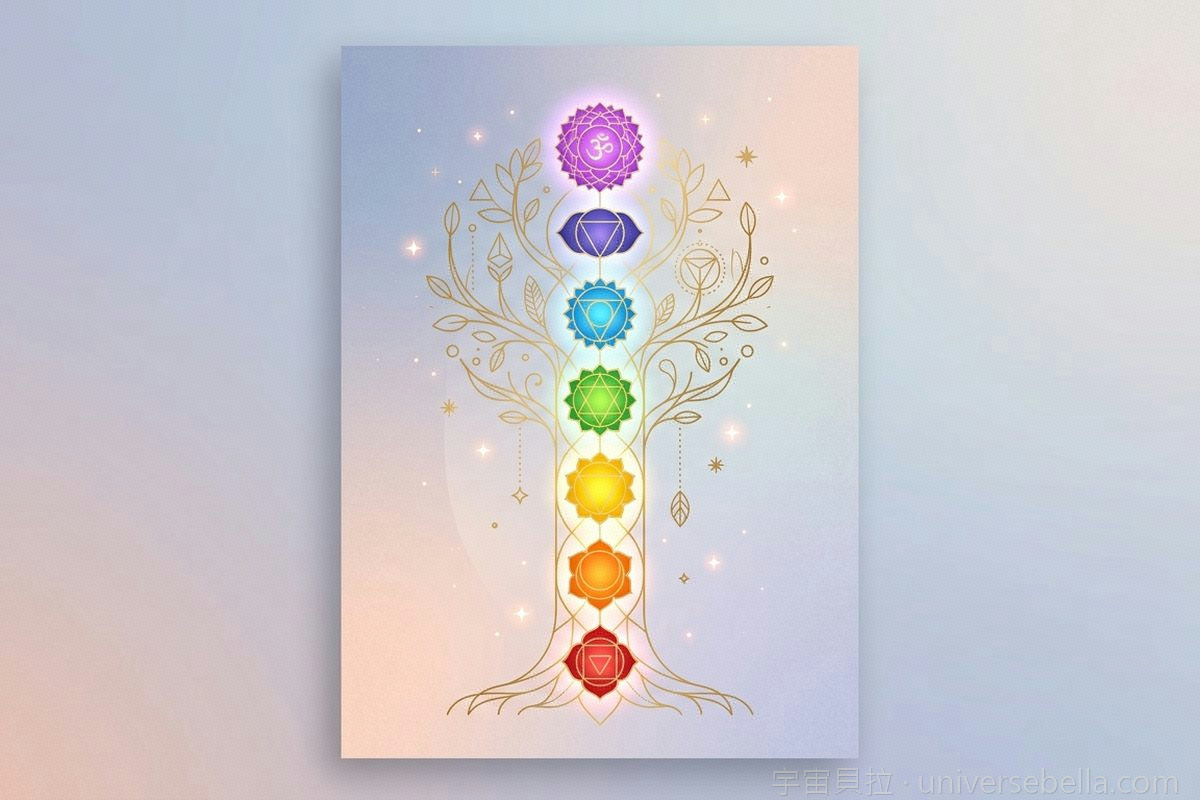
Have you ever had that feeling you can't quite name? A sentence stuck in your throat that simply won't come out. A tightness in your chest even though nothing dramatic has happened — you just feel clenched. Or that flutter of unease low in your stomach the moment a decision lands in your lap. These small bodily signals are often tied to emotion more closely than we realize. And the chakras are one way of reading the map those signals are drawing.
A chakra is an energy center: the word comes from the yogic and Ayurvedic traditions of ancient India, and it describes seven main "centers" running up the body from the base of the spine to the crown of the head. This piece isn't about complicated theory. It's a plain-language tour of the seven centers — what each one is "saying," and how you might gently tend to yourself when one of them feels stuck.
What a Chakra Actually Is
In Sanskrit, chakra means "wheel." The old image is of spinning wheels of light arranged along the body's midline. It's worth being clear up front: a chakra is not an organ a surgeon could find. It isn't a medical structure — it's a mind-body map for self-reflection. The simplest way to hold it is this: the chakras use the language of "energy" to describe where you are with different themes of being human.
The seven centers, from the ground up, track a neat progression of human needs — from "am I safe?" all the way to "am I connected to something larger than myself?" When one of those themes gets stuck in your life, the matching chakra is traditionally described as "out of balance," and you may feel it in your body or your mood. Let's walk through them one at a time.
Root Chakra: Safety, and "Do I Have Solid Ground?"
Sitting at the base of the spine, the root chakra is about safety, survival, and foundation, and it's usually pictured in red. When it feels steady, you have that grounded sense of "I can stand here, I've got a base under me." When it's off, it can show up as money fears, a low hum of anxiety, or the feeling that the floor beneath you isn't quite solid.
Tending to it can start with the most practical things: eat properly, sleep properly, stand barefoot on the ground for a minute, tidy the space you live in. A line you might say to yourself: "I am safe, and what I have right now is enough."
Sacral Chakra: Feeling, Desire, and Creativity
Just below the navel, the sacral chakra is about the flow of emotion, creativity, and your relationship with pleasure, often shown in orange. When it moves freely, you can feel at ease, let yourself want things, and find sparks of creative energy. When it's blocked, you might go emotionally numb and lose interest in everything — or swing the other way, with feelings pouring out like a tap you can't turn off.
Care for this one by doing small things that make you feel: draw, dance, take a hot bath, let yourself have a proper cry. A line to keep nearby: "I allow myself to feel, and I allow myself to enjoy."
Solar Plexus Chakra: Confidence, and "I Can Do This"
Below the breastbone, around the stomach, the solar plexus chakra holds confidence and personal power, usually pictured in yellow. When it's full, you can make decisions and trust your own abilities. When it's depleted, the classic sign is low self-worth — dismissing yourself before anyone else can, or trading away your own needs to earn approval.
You can strengthen it by stacking up small "I did that" experiences, however tiny. This is exactly why confidence is usually built from small wins rather than grand gestures — and if that's the area you're working on, these affirmations for work and self-belief offer a few lines worth repeating daily. A line to try: "I trust my own judgment, and I'm capable of facing what comes."
Heart Chakra: Love and Acceptance
In the center of the chest, the heart chakra is about love, compassion, and acceptance, commonly shown in green. It sits at the middle of the seven — connecting downward to the body and upward to the spirit — which is why many people call it the core of the whole system. When it's open, you can love others and also let love flow back toward yourself. When it's off, loving yourself feels hard, trust feels risky, and you may quietly build walls inside relationships.
From a manifestation angle, the heart center matters in a particular way: you can set all the intentions you like, but if somewhere inside you don't believe you deserve love or abundance, that energy just can't land. Opening the heart isn't a technique — it's the practice of receiving. A round of self-love affirmations is a good place to begin. A line to hold: "I am worthy of love, and I stay open to it."
Throat Chakra: Speaking Your Truth
At the throat, this chakra is about expression and honesty, usually pictured in blue. When it's clear, you can say how you actually feel and what you actually need. When it's blocked, it's that familiar sensation of words stuck in your throat — or the habit of swallowing what you really mean.
You can tend to it by journaling, writing down the thing you want to say before you say it out loud, or practicing a little honesty inside a relationship that feels safe. A line to carry: "My voice deserves to be heard, and I can speak gently and truthfully."
Third Eye Chakra: Intuition
Between the brows, the third eye chakra is about intuition and insight, often shown in indigo. When it's clear, you find it easier to trust your gut and see the whole shape of a situation. When it's off, you may over-rely on analysis, talk yourself out of your inner signals, or feel cut off from your own instincts.
Care for it by practicing quiet — meditation, fewer hours of information bombardment, a little deliberately empty time for yourself. A line to remember: "I trust my inner guidance; the answer is often already in me."
Crown Chakra: Connection to Something Larger
At the top of the head, the crown chakra is about spiritual connection — your relationship to whatever you sense as bigger than yourself — usually pictured in white or violet. When it's open, you feel a kind of trust that something larger is holding you. When it's off, life can feel meaningless, disconnected, or over-controlled, as if you have to grip everything yourself.
Tend to it through any moment that reminds you "it isn't all on me alone": sitting in stillness, getting close to nature, practicing gratitude, or simply looking up at the night sky. A line to rest in: "I trust life, and I let myself be guided by something greater."
How to Start Tending Your Own Chakras
You don't need to buy any expensive tools, and you don't need to understand all of this in one sitting. The simplest entry point is a few minutes a day moving your attention up the body from the base to the crown — which is really a stripped-down chakra scan. If you'd like something a bit more structured to follow, try a body scan meditation, working from the crown down to the soles of your feet, noticing one area at a time, without judgment — just observing where you feel tight and where you feel loose.
As you notice, if one area keeps speaking up — a chest that stays heavy, say, or a throat that stays tense — that's it talking to you. You don't have to rush to "fix" it. Simply acknowledging it's there, and keeping yourself company with the matching line above, is already a strong start. If you want to go deeper into each center's seed sound, traditional color, and fuller balancing practices, our longer complete guide to the seven chakras lays it all out.
If you'd like more of a rhythm, pick a fixed moment — just after waking, or right before bed — and spend three minutes scanning up through the seven areas, asking at each one, "Is it tight here today?" You don't have to do anything. Just calling the roll for yourself like this, day after day, makes your own energy map more familiar, and makes it easier to catch an emotion while it's still small, rather than waiting for it to build into something that breaks open all at once.
Frequently Asked Questions
Are chakras real, physical organs?
No. Chakras aren't anatomical organs. They're a mind-body map from ancient Indian tradition that uses the idea of "energy centers" to describe where you are with different themes of life. Treating them as a tool for self-awareness — rather than a medical diagnosis — stays closest to their original intent.
How do I know which chakra is out of balance?
The simplest approach is to notice which life theme you keep getting stuck on, then match it to the chakras: recurring money anxiety leans toward the root, not being able to speak your truth leans toward the throat, struggling to love yourself leans toward the heart. A spot in the body that stays chronically tense or heavy is often a clue too. This is self-reflection, not self-diagnosis — try not to label yourself.
Do I need crystals or essential oils to balance my chakras?
You don't. Crystals, oils, and singing bowls can be supportive, but mainly they work as a reminder to return to the intention. Real balance comes from everyday awareness and care — living well, feeling honestly, practicing acceptance. The tools are a bonus, not a requirement.
If I'm physically unwell, will balancing a chakra make it better?
Chakra practice helps many people relax and understand their emotions more clearly, but it isn't medicine and it's no substitute for seeing a doctor. If you have a noticeable physical or emotional problem, please seek professional help. Keep chakra awareness as one part of looking after yourself — not as a treatment.